 Working paper · August 2026Read the full report (PDF) →
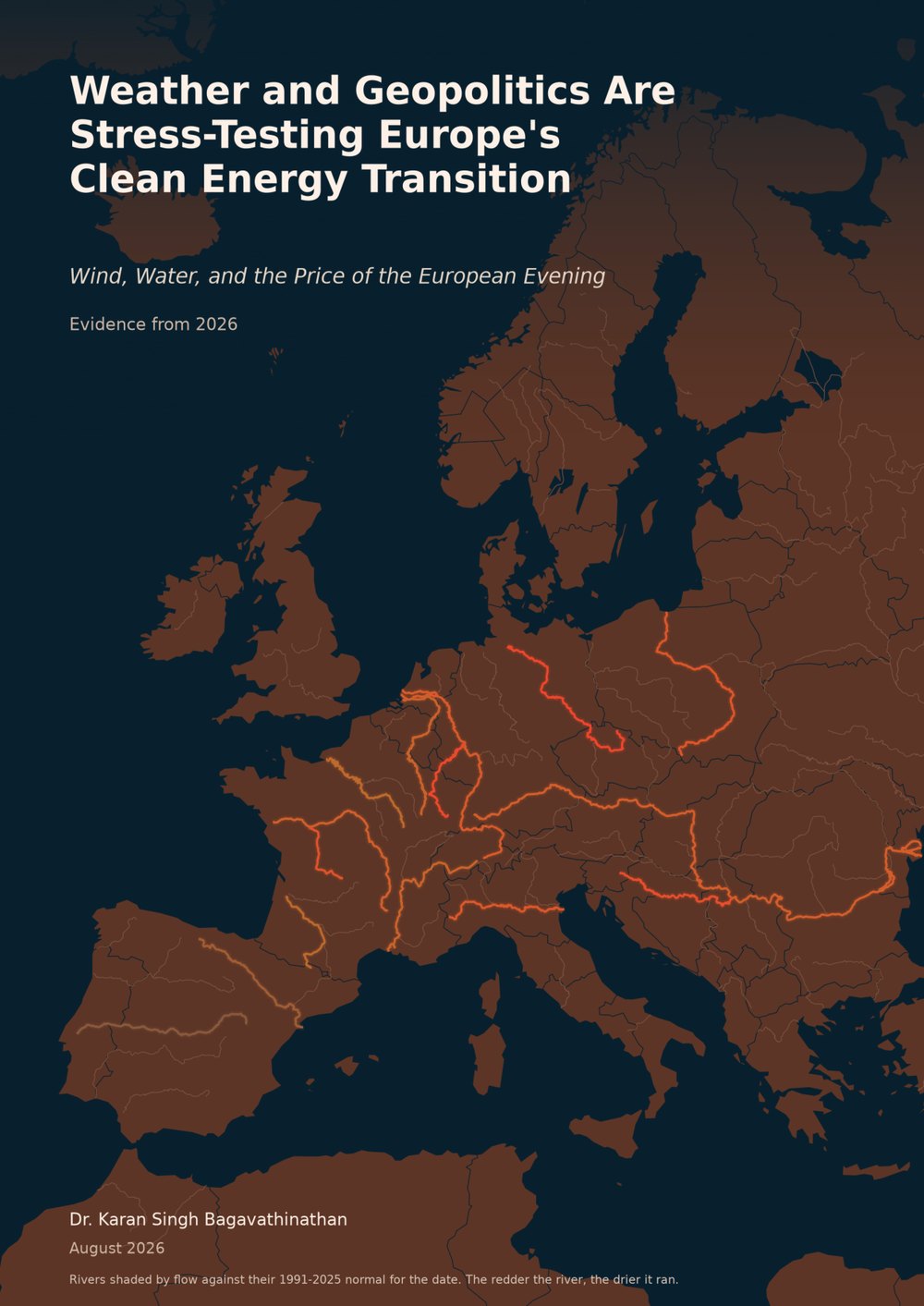
Rivers shaded by flow against their 1991–2025 normal for the date. The redder the river, the drier it ran.
Weather and Geopolitics Are Stress-Testing Europe’s Clean Energy Transition
Wind, Water, and the Price of the European Evening
By Karan Singh Bagavathinathan
August 2026 · Evidence from 2026
European power prices are usually judged by an annual average. Read instead at the resolution the system runs at, one price per bidding zone per hour on a panel of 3.9 million zone-hours ending 10 August 2026, the clean transition has moved Europe’s economic cycle in between a weather cycle and a political one. Summer 2026 had fifteen days on which ten or more of the 39 zones were hot at once against five in 2022, and heat reaches supply as well as demand. Fifteen of 35 river cooling sites ran at their lowest in 35 years, hydro’s contribution to the evening climb halved from 8.9 to 4.3 GW, and gas covered the difference. Russian gas meanwhile fell from 42 per cent of extra-EU imports to about a tenth while liquefied gas rose to 44 per cent, a real diversification into a different form of exposure, and the defence budgets the same geopolitics requires draw on the fiscal space the grid needs. Solar carried the daytime this summer and cannot carry the evening, which falls to wind, hydro or fuel. Wind is the renewable whose share tracks national income, from 60 per cent of generation in Denmark to 1.4 in Hungary, so the member states with the widest gap between a cheap midday and a dear evening are the ones that have not built it. Adjacent zones clear at the same price in only 26 per cent of hours. Expanding wind, and building the wires and the agreement between zones that would let it be shared, is the binding constraint on completing the transition. This paper identifies that constraint from price and operating evidence, and it does not estimate the environmental or the total system cost of resolving it.
* Bagavathinathan: Germany (email: vbk.singh@gmail.com; web: vbkaran.github.io). Working paper; comments welcome.